The Parenting Question Everyone Seems to Be Asking Right Now
For today's parents, smartphones can feel both essential and overwhelming. Many of us rely on them every day for everything from work and practical day-to-day tasks to socialising and entertainment. We know how useful they can be, but also how easy it is to lose time scrolling or find ourselves reaching for them out of habit.
So it's perhaps no surprise that many parents feel conflicted when it comes to their children's relationship with smartphones and social media.
It's an issue that has gained momentum across the UK, taking a significant step forward this week when the UK Government announced plans to introduce restrictions on social media access for under-16s. Here in Guernsey, it's an issue that many families will recognise. Some are choosing to delay smartphones altogether, while others are looking for ways to help children develop healthier digital habits from an early age.
But beyond the headlines and debates, many families are finding themselves wrestling with the same question:
What role should smartphones and social media play in childhood?
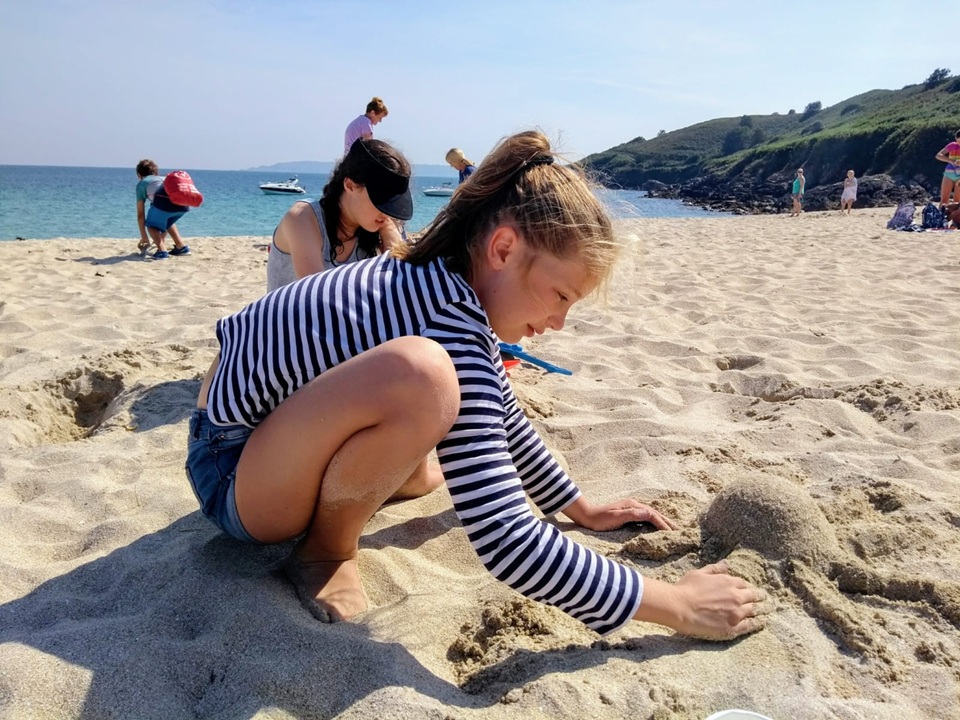
Image credit: Tracey Thomson
It's a question that sits at the heart of the Smartphone Free Childhood movement, which believes that childhood is simply too short to scroll.
We spoke to Oliver Westgarth, co-founder of Smartphone Free Childhood Guernsey, to find out more about the organisation here in the Bailiwick, why it resonates with families and what a smartphone-free childhood actually looks like.
For parents who are hearing the term for the first time, what does a smartphone-free childhood actually look like in practice?
A lot of people assume it means rejecting technology. It really doesn’t.
A smartphone-free childhood is about giving children more time before introducing smartphones and social media. Families still use computers, tablets, smart TVs and the internet. Children still learn digital skills. Many will have a basic or dumb-phone for calls and texts when out and about.
The difference is that we’re trying to separate useful technology from technologies that are increasingly being linked to poorer sleep, poorer mental health, reduced attention, weaker emotional regulation, weaker dexterity, and less time spent on the real-world activities that children need for healthy social and brain development.
Children develop through movement, play, face-to-face interaction, boredom, risk-taking, compromise, problem solving and real-world social experiences. The concern is not simply what smartphones add, but what they remove and replace.
For us, it isn’t anti-technology. In fact, many of the parents involved in Smartphone Free Childhood work in technology, education, healthcare and other professional sectors that rely heavily on digital tools.
For many years some of the most prominent figures in Silicon Valley have chosen low-tech or highly restricted technology environments for their own children, which should tell us all we need to know...
The question has never been whether digital technology is useful, it is, of course. The question is when children are ready for some of its more powerful and persuasive forms.
The UK has just announced plans to restrict social media access for under-16s. How do you think Guernsey is responding to the wider conversation around smartphones, social media and childhood?
Guernsey is very much part of a wider international zeitgeist shift, but although our movement is active and our policy makers and leaders are engaging we risk falling behind locally.
When we started Smartphone Free Childhood Guernsey just over a year ago, there were secondary school year groups where only two or three children didn’t have smartphones. Today, in most cohorts, that figure is around 25%. That’s a remarkable change in a very short period of time.
But we can’t afford to be complacent. Guernsey doesn’t automatically benefit from UK legislation or policy changes. If social media restrictions are introduced there, we will need to decide how we respond here.
One of Guernsey’s advantages is that we’re small and nimble. We have the opportunity to move quickly and show leadership if we choose to.
School phone policies are a good example, which is one of the reasons we have invited David Smith to Guernsey this year. He led the first state school in the UK to adopt a full brick-phone-only policy and has shown that significant change is possible. For us to make that a nation wide policy, we would only need to instigate it in a handful of schools. We could be the first state on the planet to do that.
It’s striking who is joining the conversation. The fastest-growing group within this movement isn’t people who reject technology, it’s parents who work in technology, design, education, healthcare and other professional sectors who have seen enough to start asking pushing back.
Governments, health professionals, educators and parents may not always agree on the precise solutions, but there is now growing recognition that there is a problem. The question is no longer whether something is wrong. The question is what we do about it.
Many parents worry about screen time, cyberbullying and social media, but still feel smartphones are inevitable. What would you say to them?
I would say that smartphones are only inevitable if we collectively decide they are.
We often use a simple analogy. If you were teaching a child to travel independently, you wouldn’t start by handing them the keys to a car. You start with a tricycle, then a bicycle, then a moped and gradually build up skills, responsibility and confidence.
Technology should work in much the same way.
A basic phone allows children to call home, arrange plans and develop independence without exposing them to social media, algorithmic feeds and everything else that comes with a modern smartphone.
Parents often tell us that once a smartphone arrives, they suddenly find themselves managing, or rather policing, social media, group chats, gaming, sleep disruption, online safety and exposure to extreme pornography all at once.
Many families find that delaying is actually easier than trying to put boundaries back in place later. Once the genie is out of the bottle, it’s very difficult to put back in.
Many adults have a complicated relationship with their own smartphones. How do you respond to parents who feel conflicted about encouraging their children to spend less time on devices when they use them heavily themselves?
That’s a very honest concern.
Many adults aren’t happy with their own relationship with technology. We know what it’s like to lose time scrolling, to feel distracted by notifications or to pick up our phones without even thinking about it.
But, the reality is, parents don’t need to be perfect before setting boundaries for children.
We don’t tell children to avoid alcohol until we’ve completely mastered our own relationship with it. Sometimes our own experience helps us recognise risks more clearly.
These technologies are designed by some of the most powerful companies in history to capture attention, build habits and keep us engaged for as long as possible, because that’s how they make their revenue. If adults struggle with that, we shouldn’t be surprised that children do too.
At the same time, this can’t just be about children. Parents need to look honestly at their own habits as well. Most of us, myself included, could probably benefit from spending a little less time on our phones.
When according to Ofcom around 25% of four-year-olds in Guernsey already have their own smartphone, and the average age of first smartphone ownership is around eight, I think it’s reasonable to ask whether we’ve normalised something that would have seemed extraordinary only a decade ago.
One of your key messages is that parents aren’t alone. Why is community support so important when it comes to delaying smartphones?
Because this is almost impossible to do alone.
The biggest fear many parents have isn’t actually the phone itself. It’s that their child will be the only child without one.
One of the most powerful things we’ve seen is parents discovering they are not alone. Smartphone-Free Childhood Guernsey now has around 600 family members locally, while the wider movement has grown into one of the largest parent-led movements in the UK, with hundreds of thousands of parents involved.
That gives families confidence. Once parents realise that lots of others share the same concerns, it becomes much easier to make different choices.
That’s really what this movement is about. It’s not about telling parents what to do. It’s about helping parents support one another.

Get content on wellbeing and local life straight to your inbox
We think you'll like these articles too...



LIVE LIFE WELL. LOVE LOCAL. LOVE THE LIST.
LIVE LIFE WELL.
LOVE LOCAL.
LOVE THE LIST.
Get content on wellbeing and local life straight to your inbox
© 2026 The List Limited. All Rights Reserved.